Stainless Steel Coffee Kettles
Latest Update: October 17, 2026
Stainless Steel Coffee Kettles, How to Compare Spout, Capacity, and Temperature Control is a practical question for anyone choosing a kettle for pour over coffee or everyday hot drinks. In 2026, focus on the stream you can control, the water you actually need, and temperature features that suit your routine.
Key Takeaways
- Choose the spout for your usual pour. A gooseneck spout guides a narrow stream, while a broader spout is often more convenient for filling larger vessels quickly.
- Plan around usable kettle capacity. Allow for the minimum fill, the water for your brew, and some water left for a comfortable pour.
- Match temperature features to your brewing habits. Variable temperature control offers choice, while presets make familiar routines simpler. Our guide to electric kettle temperature control covers the feature in more detail.
- Judge balance as well as spout shape. A steady, comfortable grip helps you control the stream from a full kettle and as it empties.
- Look beyond the stainless steel exterior. The body, lid, spout, and interior are separate areas to consider when comparing construction.
- Choose a heating style that fits your kitchen. An electric kettle may offer built in settings and a hold feature. A stovetop kettle relies on a compatible hob and separate temperature monitoring.
Match spout flow to the way you brew
For pour over coffee, choose a gooseneck spout when you want a narrow, steady stream directed over the coffee bed. Its shape helps guide water, but a balanced grip and practiced pouring technique still matter.
A broader conventional spout suits filling larger vessels or pouring quickly, because a highly restricted stream can make those tasks slow. Compare the flow at a gentle tilt and a faster tilt, since useful spout geometry should allow both control and a more generous pour when needed.
The Ulalov Electric Kettle is a pour over coffee kettle with stainless steel construction, a 0.8 to 1 liter capacity, customizable temperature control, a gooseneck spout, and a 1200 watt heating element.
Its narrow spout suits controlled pouring, and the listed temperature guidance is 200 to 205°F, or 93 to 96°C, for light roasts, 195 to 200°F, or 90 to 93°C, for medium roasts, and 190 to 195°F, or 88 to 90°C, for dark roasts.

For a comparison of different narrow spout styles, browse our guide to electric gooseneck kettles. A separate option, the Bonavita BV382510V Electric Kettle, pairs a stainless steel build with a gooseneck spout.
Readers comparing a one liter style can also explore the Bonavita 1 liter gooseneck electric kettle. It is helpful to consider the stream alongside the kettle’s handle and balance, rather than choosing by spout appearance alone.

Choose capacity around the water you actually use
Think of the advertised maximum as a ceiling, not the full amount available for brewing. Account for the kettle’s minimum fill, the water your recipe needs, and a little extra so you can pour without running the kettle nearly dry.
A smaller kettle can be easier to store and handle when you usually make one or two cups. A larger kettle can reduce repeat heating for several brews or a household, but its full weight and balance deserve attention.
The OXO Brew Gooseneck Electric Kettle with Temperature Control has a 1.7 liter capacity, a gooseneck spout, customizable temperature control, and a Keep Warm function. Its BPA free plastic handle and easy to use controls are relevant when you are comparing a larger kettle for both capacity and everyday handling.

The largest gooseneck kettle guide is useful when you are weighing a more generous volume against the controlled stream of a gooseneck spout. A different stainless steel option, the Cuisinart CPK 17 PerfecTemp Kettle, has a 1.7 liter capacity, six temperature presets, and a keep warm function that holds water at the right temperature for 30 minutes.


Compare how the kettle feels full and partly empty, because its centre of balance shifts as you pour. Capacity works best when it matches both your usual batch and the weight you can comfortably control.
Compare temperature settings and holding time
Variable temperature control gives you more choice than a single boil setting. Presets can make repeated brewing quicker when their set temperatures suit the drinks you prepare.
The Bonavita Gooseneck Electric Kettle has a stainless steel body, a gooseneck spout, adjustable settings from 140°F to 212°F, or 60°C to 100°C, and a hold temperature feature for up to an hour. That broad range and extended hold can suit a routine with several pours or a pause between brewing steps.
Compare hold time with your actual routine. A keep warm feature helps when you pause between pours, while a short wait before brewing may make it unnecessary.
For repeat drink preparation, the Breville BKE820XL Variable Temperature Kettle offers five preset temperatures, fast heating, and easy cleaning.
The Cuisinart CPK 17 PerfecTemp Kettle offers six presets, so the choice between them can come down to which set points best match your usual drinks.


Our guide to the best electric kettles with temperature control offers more detail on settings and hold features. Compare the available temperatures as well as the number of presets, since a longer menu does not help when its settings do not suit your routine.

This infographic highlights key features to compare when choosing a stainless steel coffee kettle, including spout design, capacity, and temperature control.
Separate selected temperature from pouring temperature
A selected set point, a displayed reading, and the temperature of water leaving the spout are related, but they are not identical measurements. Water can lose heat while it rests in the kettle or moves into a dripper.
To check temperature accuracy, compare the kettle display with a separate thermometer near the time and place you pour. This gives you a reading closer to the water reaching your coffee than relying on the selected setting alone.
A digital display makes the selected temperature easy to read, while a dial or preset can be simpler to operate. Choose the control style you can use consistently.
The OXO Brew Adjustable Temperature Kettle has settings from 170°F to 212°F, a capacity of up to 1.75 L, a conventional spout, and a 30 minute temperature hold. For a closer look at its controls, read our OXO Brew Adjustable Temperature Kettle guide.
The Bonavita BV382510V Electric Kettle has a gooseneck spout suitable for pour over coffee. These two examples show why it helps to compare the control interface and the way you pour, not just the temperature range.
Our article on the Bonavita gooseneck kettle gives more context on its temperature settings and pouring design.
Assess grip, balance, and pouring comfort
Hold and pour with a kettle when full and partly empty, because balance changes as water leaves the body. A steady grip and predictable tilt make it easier to control a slow stream.
Look for a handle with room for a secure hold and a wrist position that feels comfortable through the pour. A heavy or awkward kettle can make careful pouring harder, even when its spout is designed for flow control.
Consider where the handle, lid, and controls sit in relation to the pouring motion. You should be able to lift, tilt, and set the kettle down without adjusting your grip mid pour.
Understand stainless steel and routine care
A stainless steel exterior describes the outside finish, not every surface that touches hot water. Compare the body, interior, lid, spout, and visible fittings as separate material areas, especially when a kettle is described as having stainless steel construction rather than a stainless steel finish.
Rinse out standing water and dry the interior when practical. When mineral scale builds up, remove it because deposits can affect heating and leave residue.
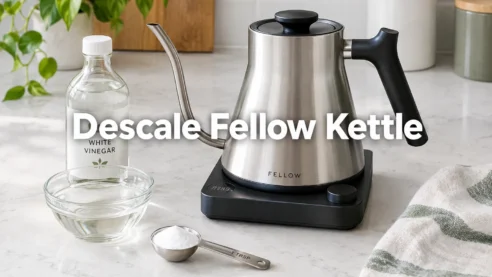
Let an electric kettle cool and disconnect it from power before descaling, then rinse it thoroughly. Avoid abrasive pads, which can scratch the finish.

Choose between electric and stovetop heating
An electric kettle heats on its base and can offer built in temperature settings or a hold feature. A stovetop kettle heats on a compatible hob, so you monitor the water temperature separately.
For pour over routines with a chosen temperature, built in control can reduce the need to monitor heating separately. For stovetop use, match the kettle base to the heat source.
Consider how soon you need water and whether you want it held warm between pours, rather than choosing by heating speed alone.
Explore our pages on electric heating and boiling control and the electric gooseneck kettle to compare the features that shape an everyday brewing routine.
Frequently Asked Questions
How much kettle water should I plan for one pour over?
Use your recipe’s total water amount as the target, then weigh it before heating for consistency.
Can I use a gooseneck kettle for tea and other kitchen tasks?
Yes, a gooseneck kettle can handle tea and other kitchen tasks that call for a controlled pour.
Does a keep warm function use electricity while it holds temperature?
Yes, an electric kettle needs power to maintain its temperature during a hold period. The amount used depends on the particular kettle and how long it holds the water.
Can I leave water in a stainless steel kettle overnight?
Water can remain in a clean kettle overnight, but fresh water is a better choice for the next brew. Emptying the kettle also makes it easier to notice and remove mineral deposits during routine cleaning.
Can I use an electric kettle on a stovetop?
No, use an electric kettle only with its electrical base.
Is a temperature-controlled kettle worth it?
It is most useful when your routine calls for water below a full boil; otherwise, a simple boil setting may be enough.
What is the healthiest kettle to boil water in?
Choose a kettle with an interior and water-contact surfaces made from materials intended for repeated contact with hot water, such as stainless steel. Check the body, lid, and spout separately, since a stainless steel exterior does not mean every surface that touches the water is stainless steel.
Conclusion
Choosing a Stainless Steel Coffee Kettles comes down to matching the spout, usable capacity, temperature control, and handling to the way you brew.
Compare the stream at different pouring speeds, consider the balance when the kettle is full and partly empty, and choose temperature settings that support your routine.
For 2027, Stainless Steel Coffee Kettles, How to Compare Spout, Capacity, and Temperature Control remains a useful framework for finding a kettle that fits both pour over coffee and everyday kitchen use.