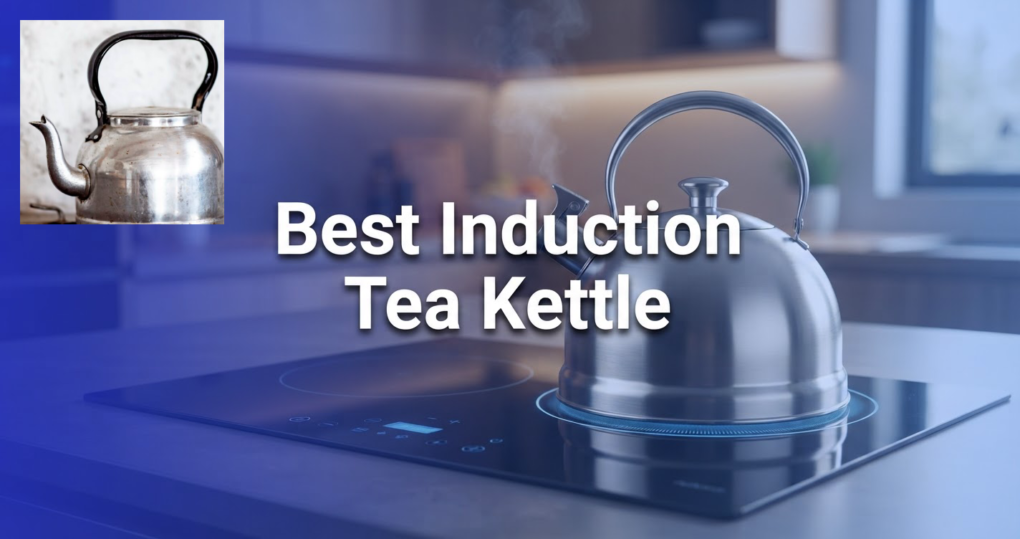
Best Tea Kettle For Induction Stove
Latest Update: November 05, 2026
The Best Tea Kettle For Induction Stove is one with a magnetic base that your cooktop can detect, a capacity that suits your routine, and a shape you can pour comfortably. We compare the features that matter, from base fit and materials to spouts, handles, and care.
Based on the product details presented, the GIPFEL is the clearest overall pick for an induction stove: its induction capsule bottom is specifically identified, and it also has a whistle and an adjustable-position handle.
This is a feature-based recommendation, not a measured speed ranking; confirm the maker’s compatibility specifications and your cooktop’s zone requirements before buying.
Key Takeaways
- What tea kettles work on an induction cooktop? Models with a suitable ferromagnetic base that meets the cooktop’s detection requirements. Read our guide to stainless steel and induction compatibility for more on magnetic bases.
- What should we check first? The kettle maker’s compatibility details, the base diameter, and your cooktop’s minimum pan diameter.
- Does a wider base mean faster boiling? No. Compare kettles on the same zone with the same amount and starting temperature of water.
- What capacity suits a household? A smaller kettle works well for a few cups, while a larger household may prefer room for several servings.
- Which spout suits pour over coffee? A gooseneck spout gives a more controlled stream. A conventional spout is often more practical for filling several cups quickly.
- What helps with comfortable pouring? A secure handle, adequate finger clearance, and a lid that is easy to open and close.
Confirm that the kettle works with induction
Induction transfers energy through a magnetic field, so a kettle needs a ferromagnetic base for the cooktop to heat it. Stainless steel alone does not guarantee compatibility, because some stainless steel alloys are not magnetic.
A magnet sticking to the base is a useful first clue, not final proof. Confirm the kettle maker’s compatibility specifications and compare the base with your cooktop’s minimum pan diameter and detection requirements.
Place the kettle flat and steady on the cooking zone, centered over the marked area. If the cooktop does not detect it, check that the base meets the zone’s size requirements before heating.
To compare induction performance, use the same cooktop, water amount, starting temperature, and settings for each kettle.
Results from a different stove type do not establish how quickly a kettle will heat on induction. The product details do not provide comparable boil times, so they do not support a fastest-kettle ranking.
For an induction kettle with an induction capsule bottom, consider the GIPFEL International Whistling Tea Kettle. This 2.3 quart food grade stainless steel model has a whistling alert system and an adjustable position handle, and costs $119.99.


The SUSTEAS Stove Top Whistling Tea Kettle is surgical stainless steel, with a 2.64 quart capacity and a 3 quart maximum boiling capacity. It has a whistling feature and works on induction.
A stovetop kettle uses the cooktop as its heat source, while an electric kettle has its own heating element and operates separately from the stove.
If you want to compare more options, our guide to kettles for induction cooktops discusses additional designs.
Match the base to the cooking zone
Choose a base diameter that fits the induction zone’s detection area. A base that is too small may go undetected, while one that extends far beyond the zone may heat less evenly.
A wider base adds contact area, but it does not guarantee faster boiling. Compare kettles on the same zone with the same amount of water and the same settings to judge their practical heating performance.
Look for a flat, stable base that sits securely rather than rocking on a rounded or visibly warped bottom. Our guide to induction optimized five layer bases explains how layered construction can combine magnetic material with other metals.
If a centered kettle still goes undetected, compare its base diameter with the cooktop’s stated minimum pan diameter. Choosing a base that meets that requirement is more useful than relying on the kettle’s overall width.


Compare materials and their care needs
Stainless steel is practical for everyday use, but its name does not establish induction compatibility. The base construction determines whether it has the magnetic material the cooktop needs.
The Le Creuset Tea Kettle is a 2 quart model with a whistling feature, a heat resistant handle, and a flat base for even heat distribution. It has an enamel-on-steel construction; use a secure grip when it is full and avoid impacts that could chip the enamel.
The Copper Bottom Tea Kettle has a stainless steel body with a copper bottom and is compatible with induction cooktops.
Copper can spread heat across a base, but copper itself is not ferromagnetic. For induction use, the kettle still needs a magnetic base construction.
To clean mineral scale, use a suitable mild descaling method and rinse the kettle well. Avoid abrasive tools on enamel, and dry the kettle, lid, and spout after washing.

Choose a capacity that fits your routine
For one or two cups, a smaller kettle helps avoid heating water you will not use. A larger household may prefer enough room for several servings, especially when making drinks for guests.
Use the fill line when the kettle has one and leave space below the spout. Filling beyond the marked level can cause boiling water to spill, and a full kettle should feel balanced when lifted.
The All Clad Stainless Steel Tea Kettle has a 2 quart capacity, a whistling feature, an ergonomic handle, and a flat base for even heat distribution. It is compatible with induction, making its capacity a useful size to compare with the smaller Le Creuset Classic Whistling Kettle.
The Le Creuset Classic Whistling Kettle holds 1.6 quarts, or 1.5 liters, and has an enamel on steel construction with a carbon steel core and porcelain enamel exterior. It works on induction and other stovetop types, making its smaller capacity a practical comparison for fewer servings.
Pick a spout and whistle for the way you pour
A conventional spout suits general pouring, while a gooseneck spout gives a slower, more controlled stream for pour over coffee. That precision can be useful for a careful pour, but the narrower stream takes longer when filling several cups.
A whistling spout signals that water has reached a boil, but it does not turn off the cooktop. Stay nearby and switch off the heat promptly when the kettle whistles.
Check that the spout and lid provide access for filling and cleaning. A narrow opening can make it harder to remove scale or dry the inside of the kettle.
Our article on traditional and modern whistling stovetop kettles offers more context on whistle and spout designs.
Prioritize a secure handle and easy lid access
Choose a handle that gives your hand a secure grip and keeps fingers clear of the hot kettle body while pouring. A heat resistant or stay cool handle can make handling easier, but metal surfaces and steam near the lid and spout still require care.
Check that the lid opens wide enough for filling and cleaning, then closes securely to limit splashing during a pour. Judge the handle with the kettle full, because added water changes its balance and the effort needed to control it.
The cards describe different contexts: one gives a general efficiency figure for an induction stove or hot plate, while the other refers to a mini-experiment with an induction hotplate.
Neither is a kettle-specific measurement or a side-by-side result for these models, so use a same-cooktop comparison to judge kettle heating.
Keep the kettle clean and ready to use
Empty leftover water after use and dry the inside, lid area, and spout to reduce lingering moisture and mineral deposits. Descale when buildup appears, then rinse thoroughly so cleaning residue does not remain inside.
Use nonabrasive tools on enamel and avoid knocks or sudden temperature changes that can damage its coating. Do not heat a kettle empty or fill it past its marked limit, since either mistake can damage the kettle or cause a spill.
Frequently Asked Questions
Does the whistle turn off an induction cooktop automatically?
No, the whistle is an audible signal and does not send a command to the cooktop. Automatic shutoff depends on the cooktop’s own controls and features.
Can I use an induction adapter plate with a kettle my cooktop does not detect?
An adapter plate sits between the induction zone and the kettle, allowing the zone to detect the plate instead. It adds another heated surface, so use a plate designed for induction and follow its handling instructions.
Why might a whistling kettle fail to whistle even when the water is boiling?
Steam may escape around a lid that is not seated properly instead of passing through the whistle. Mineral buildup or debris in the whistle opening can also interfere with its sound.
Can an induction compatible kettle also be used on a gas or electric stove?
Many induction compatible kettles are also made for gas and electric cooktops, but the permitted heat sources depend on the individual model. The GIPFEL and SUSTEAS kettles are also compatible with other cooktop types.
Conclusion
The Best Tea Kettle For Induction Stove combines a compatible magnetic base, a stable fit on your cooking zone, and a capacity and pouring style that suit your kitchen.
Compare materials, handle comfort, lid access, and care needs alongside induction compatibility to choose a kettle you can use with confidence.





Pingback: Can You Put a Glass Teapot on the Stove? Full Safety Guide
Pingback: Induction Optimized 5 Ply Bases: Worth the Investment in 2026? - Stainless Steel Tea Kettles