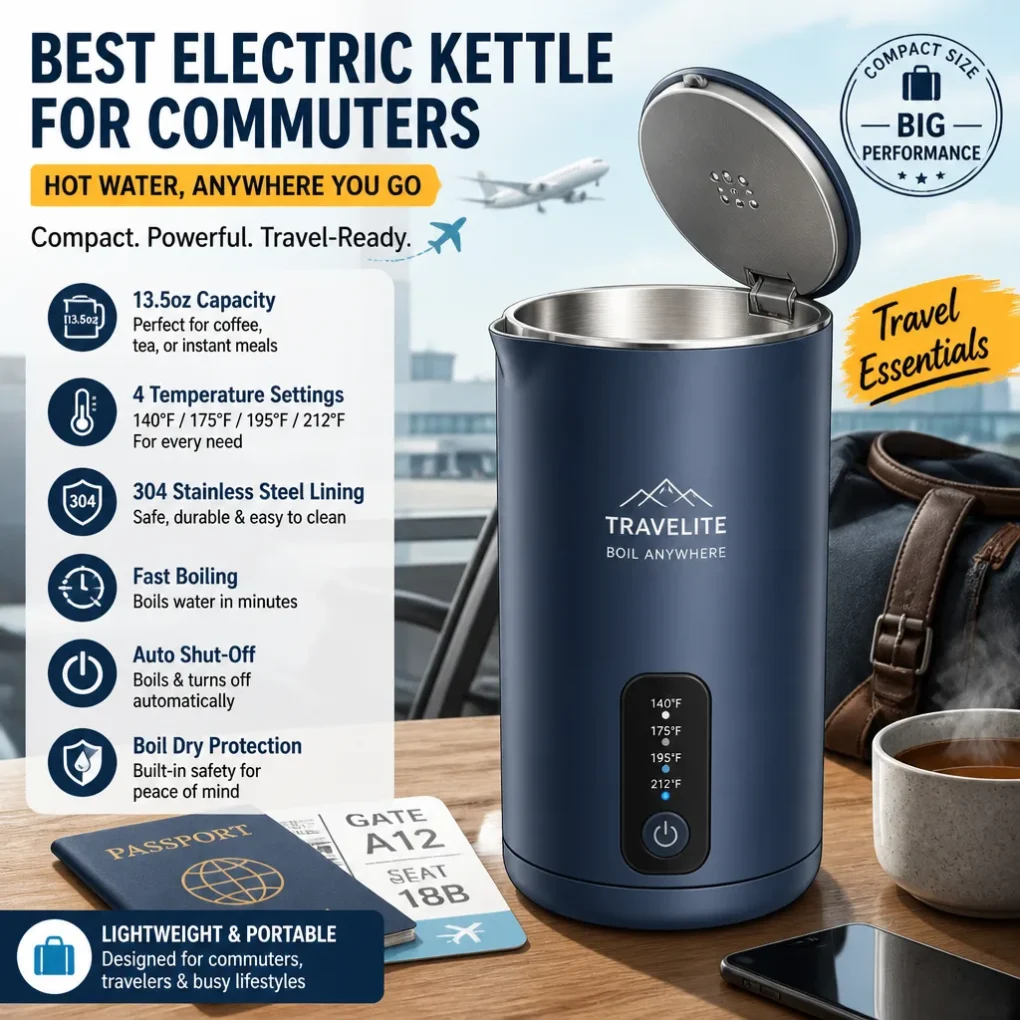
Best Electric Kettle for Commuters
Latest Update: October 26, 2026
An Electric Kettle For Commuters should suit the way you travel, the space you can spare and the power available where you plan to use it. We compare capacity, heating time, temperature controls, safe handling and cleaning so you can choose a portable electric kettle that fits your daily routine.
Key Takeaways
- Choose capacity for the number of drinks you usually make, then compare the kettle’s full shape and packed accessories.
- A travel kettle for a wall outlet is not automatically compatible with a vehicle power outlet. See our guide to a car electric kettle for the difference.
- For one drink, a compact capacity around 350 ml can be practical. A larger kettle gives you more hot water for a second cup.
- Temperature presets suit familiar drinks, while manual controls give you more choice. Our portable kettle temperature control guide covers those features.
- Let the kettle cool, empty it and dry it before packing. A compact design does not automatically make it leak resistant.
- If there is no suitable outlet, an insulated flask can provide hot water without running an appliance during the commute.
Choose a size that fits your commute
Start with how much water you use at one time. Heating only what you need can shorten the wait and avoids spending energy heating water you will leave behind.
Around 350 ml can suit one drink, while a capacity closer to 600 ml leaves room for a larger mug or another serving. Compare the filled kettle as well as its empty shape, because a tall bottle style and a wide kettle can fit a bag quite differently.
Our mini kettle guide and portable kettle size advice cover the practical difference between small capacity and a compact packed shape. Also account for the cord, base, handle and whether the kettle needs to stay upright.
For a solo drink and tight storage, the Global Travel Kettle and Elite Cuisine Dual Voltage Travel Kettle show two compact capacity options.
The Global Travel Kettle holds 350 ml and is designed to fit into tight luggage spaces, while the Elite Cuisine model holds 0.6 L and has a cool exterior and a hinged locking lid designed to prevent spills during transit.


For an Electric Kettle For Commuters, do not judge portability by the empty kettle alone. A handle that cannot fold, a separate base or a cord that needs its own space can change how easily the full setup fits into your bag.
Match the kettle to the power source
A compact travel kettle is not automatically a car kettle. A vehicle power outlet may not supply the voltage or wattage required by a kettle intended for a standard wall outlet, so compare the kettle rating with the vehicle outlet or workplace circuit before use.
Dual voltage refers to compatibility with supported mains voltages. It does not mean that the kettle will work from a vehicle outlet, and a portable power station also needs sufficient output for the kettle’s stated wattage.
Heating time depends on both power and the amount of water, so compare a kettle’s stated wattage and capacity when estimating the wait.


Never operate a kettle while driving. Set it up only when parked, on a stable, level, heat safe surface, with the cord clear of the driver and other equipment.
Decide whether temperature settings matter
Different drinks suit different water temperatures. Green tea is often prepared with water around 70 to 80 degrees Celsius, while black tea is commonly steeped with water near boiling.
For pour over coffee, water around 90 to 96 degrees Celsius can support a consistent brew, and a controlled pour helps direct water across the grounds.
Presets make a familiar drink simpler to prepare, while manual adjustment gives you more deliberate control.
A keep warm function is useful when you expect to use the water later. If you drink immediately, holding the water hot uses power without adding much value to that routine.
The Jettle Electric Kettle is a 450 ml bottle style kettle with 12 temperature settings, a one touch fast boil button, a food grade stainless steel interior and double layer insulation.
At $44.99, it suits commuters who want several temperature choices in a portable shape.

Temperature control can make a portable kettle more useful for a regular drink routine, while a simple boil button suits people who mainly want hot water. Compare the control layout with the drinks you actually make, rather than choosing a long list of settings you will rarely use.


Prioritise safe handling and transport
Automatic shutoff and boil dry protection are useful safety features. Fill the kettle within its marked limits and keep vents clear so it can operate as intended.
Open the lid carefully and keep hands away from escaping steam, which can cause burns even when the outer surface stays cooler. Let the kettle cool, empty it and dry it before packing unless its design supports another method.
The Aigostar Foldable Travel Kettle has BPA free materials, dry burn protection, automatic shutoff, a retractable handle and temperature control. Its foldable design suits travel and outdoor use, and the protective features are useful when you want a portable kettle with straightforward handling.

Keep hot water and cords away from the driver and from bag openings. Avoid carrying a freshly boiled, full kettle through a moving vehicle, because a sudden shift can spill its contents.

Compare interior materials and cleaning needs
A stainless steel interior is durable and resists corrosion, and food grade stainless steel describes material intended for contact with food. Double wall insulation can reduce heat transfer to the outside, but a recently boiled kettle still needs careful handling.
The Travel Electric Kettle holds 450 ml and has a 304 stainless steel interior, BPA free materials, four temperature presets, automatic shutoff, double wall insulation, an HD LCD and a touch screen. Its listed features make it a practical choice for commuters who want drink controls and a compact capacity together.

After use, empty leftover water and leave the lid open so the interior can dry. That simple routine helps limit stale odors and mineral buildup between commutes.
For limescale, use a suitable descaling solution such as citric acid, then rinse the kettle thoroughly. Avoid abrasive scouring pads, which can scratch the surface, and keep the care routine simple enough to repeat regularly.
Fit kettle use into a practical commute routine
Heat water only after parking or reaching a stable work area. Place the kettle where its cord cannot be snagged and where steam will not reach people or equipment.
If you need hot water during travel and have no suitable power source, an insulated flask is a straightforward alternative. It lets you carry hot water without operating an appliance in a vehicle.
At work, use an available workplace kettle when it is convenient and permitted rather than carrying equipment for a routine that already has access to hot water. Plan filling and emptying near a sink or another stable area, not over a bag, seat or crowded walkway.
Browse our small electric kettle advice for compact use, or our guide to the best travel kettle for hotels and vacations for more portable use ideas.

Typical electric kettles convert 80 to 90% of electrical energy into water heat.
Treat the efficiency percentages above as broad context, not a product comparison: one is framed as an ideal-condition claim and the other as typical, and no shared test method accompanies them.
Neither establishes which named kettle uses less energy or boils faster. For a commute, check the kettle’s stated wattage and heat only the water you plan to use.
Frequently Asked Questions
Can I leave a portable kettle plugged in between uses?
Unplug it after use unless its instructions explicitly describe a safe standby mode. This also prevents the kettle from drawing power when you are not using it.
Does hard water affect how often a compact kettle needs descaling?
Yes. Hard water leaves mineral deposits more quickly, so the kettle may need descaling more often than one used with softer water.
Is a travel kettle suitable for sharing in a small office?
It can suit shared use when colleagues agree on where it will sit and how it will be cleaned. A compact kettle with clear controls can also make it easier for different people to use the same routine.
Can high altitude change the temperature at which water boils?
Yes. Lower air pressure at higher elevations means water boils below its usual sea level temperature, which can affect recipes and drink routines that depend on a precise temperature.
Can a portable kettle run from a portable power station?
It can if the station supports the kettle’s voltage and supplies enough continuous output for its wattage. The station’s stored energy also determines how much kettle use it can support.
Why does my kettle stop heating before the water seems fully boiled?
Mineral buildup is one possible reason for early shutoff, but it is not the only one; water level, lid or steam-path seating, base contact, or a control fault may also be involved. Check the fill mark and manual, clean as directed, and stop using the kettle if it continues.
See also: Product Listing.
Conclusion
The Best Electric Kettle For Commuters is the one that fits your drink routine, packed space and available power source. Compare capacity, full size, wattage, temperature control, safe handling and cleaning needs before choosing a portable electric kettle.
For an office routine, a compact kettle with the right controls can be convenient; for a commute without a suitable outlet, an insulated flask may be simpler.
Match the kettle to where you will use it, and make safe setup and careful packing part of your daily ritual.





Pingback: Small Electric Kettles: When Less Capacity Makes Sense - Stainless Steel Tea Kettles
Pingback: Portable Electric Kettle Size: For Travel and Everyday Drinks - Stainless Steel Tea Kettles