Fast Boil Isn’t Always the Best Electric Kettle
Latest Update: October 27, 2026
A Fast Boil Isn’t Always the Best Electric Kettle for every kitchen, because speed is only one part of the daily experience. A “quick boil” label or wattage alone cannot identify the fastest kettle; only a matched timed comparison can. We look at boil time alongside kettle capacity, temperature control, pouring, safety, and the way you actually make drinks.
Key Takeaways
- Compare boil time using the same amount of water at the same starting water temperature. Our guide to wattage and kettle speed explains why the rating alone is not a reliable speed ranking.
- A kettle that heats only the water you need may suit your routine better than one with the fastest full capacity boil. The boiling time and energy calculator lets you consider volume, power, and starting temperature together.
- Choose a boil only kettle for routine boiling, and adjustable temperature settings when you often prepare drinks below boiling.
- A standard spout is practical for general kitchen use. A gooseneck spout gives more control for a slow, directed pour.
- Automatic shutoff, boil dry protection, easy cleaning, and a cordless base all contribute to everyday convenience.
- Choose by your typical batch, drinks, pouring method, and use frequency, not by a single speed claim.
How to compare boil times fairly
Boil time only tells you something useful when the comparison begins with the same volume of water at the same starting water temperature.
A kettle heating a small, room temperature batch has less water and less temperature to overcome than one heating a full reservoir of colder water.
Wattage is a helpful clue because it describes how much electrical power a kettle uses, but it does not guarantee a speed ranking.
Kettle capacity, how effectively the heating element transfers energy to the water, mineral scale, and the household electrical supply can all affect the result.
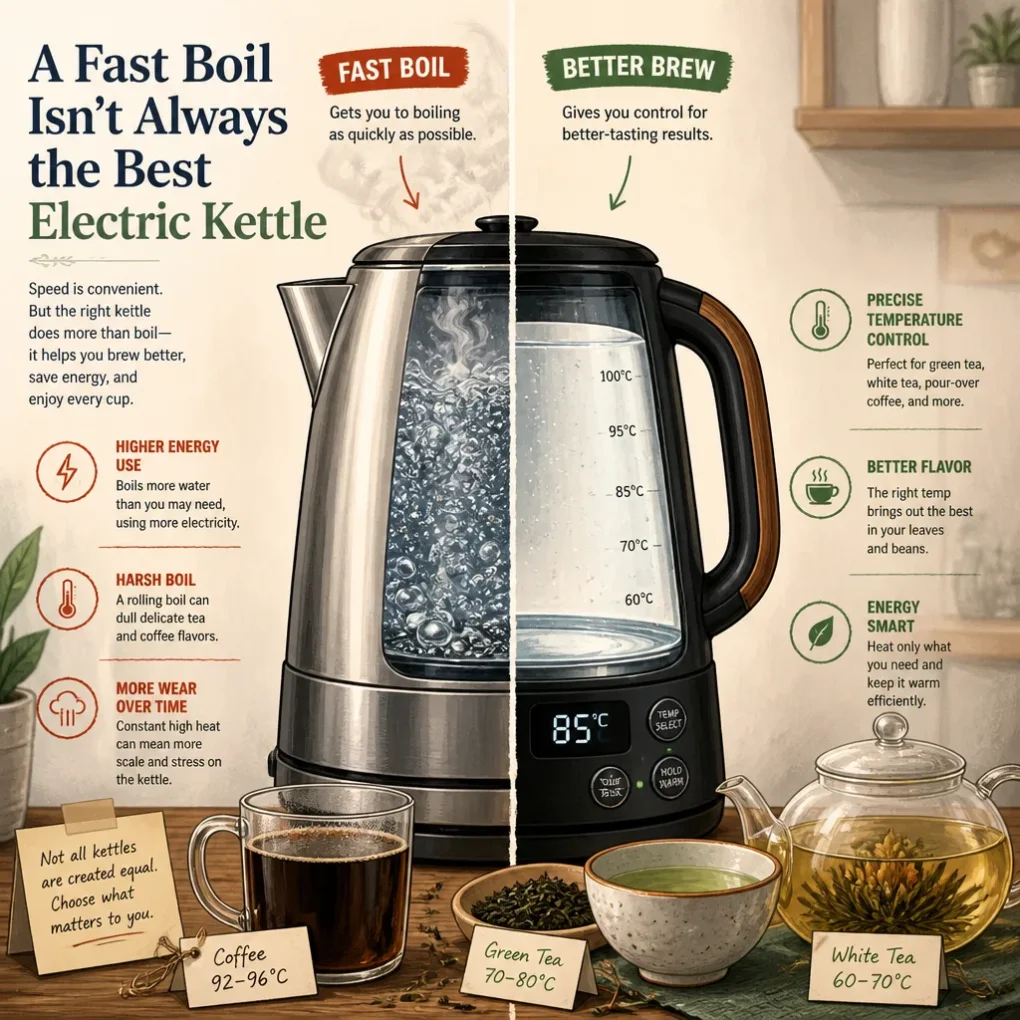
We also distinguish a rolling boil from a lower brewing temperature. A variable temperature kettle that stops at a selected temperature can finish sooner than a full boil model because it stops heating earlier, which can suit a drink that calls for cooler water.
For a fair comparison, note the quantity, starting temperature, and endpoint, then compare kettles under those same conditions.
The most useful speed test is often the one that reflects your routine, because heating a cup or two can matter more than knowing which kettle has the fastest full capacity boil.
The listed wattage and capacity are specifications, not timed performance results, so they do not identify a verified fastest model.
For a fair comparison, test the same measured water amount from the same starting temperature to the same endpoint, using the same outlet and a clean kettle each time; repeat the run and record the results.
Faster boiling also does not automatically mean less electricity: heating the same amount through the same temperature rise generally requires similar energy, while a higher-wattage kettle draws power faster and may finish sooner.
Efficiency, heat loss, and overfilling affect total use.


Match kettle capacity and power to your usual batch
Choose kettle capacity around the amount you normally heat. Filling a large kettle for one cup adds water that your drink does not need, so it takes longer to heat and leaves more hot water behind.
Use wattage alongside capacity when comparing kettles. A higher rating may help, but it does not establish how fast a particular kettle heats your usual quantity.
Clear water level markings also help you measure small batches without guessing.
The Cellecor CEK15 QuickBoil and Quick Boil 700 illustrate two different options for matching a kettle to the batch.
The Cellecor runs at 1350 watts, with a stainless steel inner body and boil dry protection, while Cello’s compact Quick Boil 700 holds 0.5 liters and has a stainless steel body with a 360 degree cordless base.
A representative UK survey found that nearly two thirds, 65%, of participants at least occasionally boiled too much water in a kettle, according to Sustainability, Fraunhofer Institute for Systems and Innovation Research ISI, and the Swedish Energy Agency.
Choosing a batch size that matches the task is a practical way to avoid routinely heating extra water.
The Quick Boil 700 is the clearer fit for a single cup or compact serving: its 0.5-liter capacity limits how much water you need to heat.
The Cellecor’s 1350-watt rating and boil dry protection are useful specifications, but do not prove it will finish a given batch faster.
Compare them using the same water amount and starting temperature; choose the smaller model for batch fit, not an assumed speed advantage.


The 20% figure is a possible saving, not a guarantee for each household. The UK survey cited above indicates that overfilling happens, but it does not establish what an individual household would save; that depends on how much extra water is routinely heated.
Decide whether you need temperature control
A boil only kettle is a sensible choice when your routine mainly needs boiling water. Extra settings add little value if you always want the same endpoint, and simple controls can make everyday use more straightforward.
Choose adjustable settings when you regularly prepare tea or coffee with water below boiling. The kettle can stop at your chosen temperature rather than heating water to a full boil and leaving you to wait for it to cool.
Temperature accuracy matters because a setting is useful only when it is easy to select and repeat. Look for controls that make the chosen temperature clear, and consider whether labeled presets or a manual setting better match the drinks you prepare.
The Ninja Precision Temperature Electric Kettle offers manual temperature setting and presets for coffee and five types of tea.
Presets make repeat brewing more convenient, while manual selection gives you control when you want to set a particular target.
A keep warm function is handy when you make several drinks in a short period. It can hold water at a useful temperature between servings, saving you from restarting a full boil each time.


Choose a spout for the way you pour
A standard spout suits quick filling and general kitchen tasks, including pouring water into cups or pans. A gooseneck spout narrows the stream and gives you more control when you want a slow, directed pour.
For pour over coffee, a gooseneck can help you keep the stream steady across the grounds. If you mainly fill mugs quickly or use the kettle around the kitchen, a standard spout is often the more convenient shape.
When you prepare different drinks, temperature selection and pouring control can work together. The Oxo Brew Gooseneck Electric Kettle has adjustable temperature control from 140F to 212F, a built in timer, a gooseneck spout, stainless steel construction, and a 360 degree swivel base.
That combination can help when you want both a chosen water temperature and a measured stream. For faster general pouring, prioritize the spout shape that feels natural for your usual cups and kitchen tasks.
Weigh everyday convenience, safety, and care
Automatic shutoff ends heating after the water boils, while boil dry protection is designed to stop operation when the kettle has too little water.
These features make regular use more convenient and help prevent the kettle from continuing to heat without enough water inside.
A wide opening gives your hand or a cleaning brush better access to the water chamber. A cordless base also makes it easier to lift and pour, especially when the kettle is full.
The Speed Boil Electric Kettle, 1500W, 1.7L pairs a 1500 watt rating and 1.7 liter capacity with a borosilicate glass body, a 360 degree base, a wide cleaning opening, automatic shutoff, and a cool touch handle.
Its opening and base are practical features to compare alongside its heating power.
Keep the electrical base dry, and descale the water chamber when mineral buildup appears. Deposits can interfere with heat transfer, and cleaning them before they accumulate heavily makes routine care simpler.
For long term value, consider warranty coverage and how easily you can carry out regular cleaning. A kettle that is simple to use and maintain can be a more useful daily appliance than one chosen only for a fast first boil.
Make the choice by your daily routine
For occasional single cups, prioritize manageable capacity and clear water level markings. That makes it easier to heat a small batch instead of filling the full reservoir.
For several cups in succession, choose a larger capacity and consider whether a keep warm function would make serving easier. Repeatedly starting a new boil can interrupt a busy routine.
For varied tea and coffee, focus on temperature settings that suit the drinks you actually prepare. A simple boiling task, prioritize straightforward controls, safe shutoff, and easy cleaning instead.
Also for general kitchen pouring, choose a standard spout. For careful pour over, choose a gooseneck only when its controlled stream is more valuable to you than faster filling.
- Start with the batch. Decide how much water you usually heat at one time.
- Choose the endpoint. Pick boil only operation or adjustable temperature based on your drinks.
- Match the pour. Select a standard spout for general use or a gooseneck for directed pouring.
- Check daily usability. Compare markings, shutoff, boil dry protection, cleaning access, and cordless handling.
Frequently Asked Questions
Why does an electric kettle sometimes click off before the water looks fully boiled?
Many kettles use steam near the lid or handle to trigger a temperature switch, so the switch can click before you see vigorous bubbling across the whole surface. If it happens repeatedly, clear any visible mineral deposits around the lid and spout, then let the kettle cool before using it again.
How often should I descale an electric kettle?
The right interval depends on how hard your water is and how often you use the kettle. Follow the care directions for your model, and shorten the interval if scale returns quickly after cleaning.
Can I reboil water that has cooled in the kettle?
Yes, cooled water can be heated again. If the water has been sitting for an extended period, empty the kettle and refill it with fresh water for a cleaner tasting cup.
Can I heat milk in an electric kettle?
Use an electric kettle for water rather than milk. Milk can foam over, scorch onto the heating surface, and leave residue that is difficult to clean from the chamber.
Why does my kettle make a rumbling sound as it heats?
The sound usually comes from bubbles forming near the heating surface and moving through the water. A change in the usual sound can also be a cue to clean visible mineral scale from the chamber.
Should I leave water in the kettle between uses?
Leaving water in the kettle is convenient, but emptying it after use helps limit the time mineral rich water sits against the chamber. Let the kettle cool before emptying, and keep its electrical base dry.
See also: B01lzZ725.
Conclusion
A Fast Boil Isn’t Always the Best Electric Kettle because the best choice depends on your batch size, preferred drinks, pouring style, and daily habits.
Compare speed under matching conditions, then weigh capacity, temperature control, safety features, cleaning access, and long term convenience.
For 2027, choose a kettle that makes your usual routine easier rather than relying on a single boil time claim.
A reliable fit for your kitchen is worth the investment when it handles the way you actually heat and pour water.