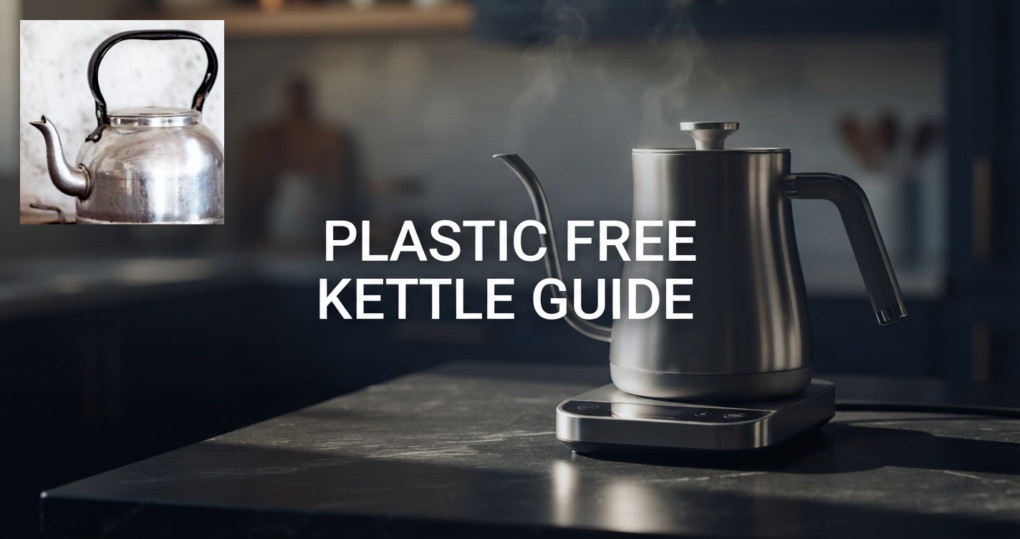
Plastic Free Electric Kettle Collection
Latest Update: October 22, 2026
To keep plastic out of contact with water, check the inner vessel and every exposed surface, including the lid underside, spout filter, water level window and seals, not just the outer shell. Models below list stainless-steel interiors, but verify the remaining water-contact parts for the exact version.
Key Takeaways
- Define your standard. A kettle with no plastic touching water can still have plastic on its exterior, base, cord or controls.
- Inspect each water contact part. Pay particular attention to the lid underside, spout filter, water level window and any lid gasket.
- Choose a material for your priorities. Stainless steel is durable and opaque, while borosilicate glass makes the water visible. Ceramic is another option, with more weight and a greater chance of chipping.
- Match the capacity to your habits. A compact kettle suits small pours, while a larger capacity is practical when you regularly boil water for several servings.
- Use labels precisely. BPA free describes a specific material claim. It does not establish that every water contact part is free of plastic or silicone.
- Compare construction and controls. Our plastic free kettle guide is a useful starting point for comparing material choices and designs.
What Plastic Free Means for an Electric Kettle
For a Plastic Free Electric Kettle Collection, start by defining whether your priority is no plastic in contact with water or an appliance with no plastic anywhere. The first standard is practical to assess by checking the kettle’s inner vessel and every part that water can touch.
A completely plastic free appliance, including its electrical parts, is a much broader requirement. The base, cord, plug, handle, control panel and insulating parts can use materials that are separate from the kettle’s water contact surfaces.
Silicone deserves its own check. It is a synthetic elastomer rather than the same type of material as rigid plastic, so decide whether you also want to avoid silicone seals or gaskets that touch water.

When comparing an electric kettle with a stovetop model, consider the whole setup. A stovetop kettle avoids an electric base, while an electric model can offer automatic shut off, temperature control or a keep warm setting.
How to Verify the Lid, Filter and Water Level Window
Use the same inspection process for every model, rather than relying on a general product description or a photo of its outer body.
- Identify the exact model and region. Product names can cover different versions, and the construction can vary between models or markets.
- Inspect clear photos of the interior. Look at the lid underside, the inside of the spout, the spout filter and any water level window.
- Read the material details part by part. Look for explicit descriptions of the inner vessel, lid, filter and seals, not only phrases such as stainless steel body.
- Check the gasket separately. A lid gasket may be silicone or another material even when the main vessel is stainless steel or glass.
- Ask the manufacturer about any uncertain part. Name the exact model and ask which materials touch water during ordinary use.
- Use customer reviews as supporting details, not proof. Reviews can point out features worth investigating, but they may describe a different version or earlier construction.
A BPA free label only addresses a claim about BPA. It does not mean the kettle has no plastic, establish the material of the spout filter, or answer whether a silicone seal contacts water.
Stainless steel on the exterior is not proof that the lid, filter or inner vessel uses the same material. Likewise, a glass body can still have a plastic part inside the lid or spout, so inspect those areas directly.
These figures are findings attributed to the linked University of Queensland research, not measurements of the kettle models listed here.
They provide context for checking water-contact materials, but do not show that every kettle releases the same amount or establish a health effect.
Stainless Steel, Glass and Ceramic Compared
Stainless steel is a strong everyday choice. It is opaque, so the water level is less visible through the body, and scale can be easier to notice against a darker or brushed interior than against a clear glass wall.
Borosilicate glass lets you see the water and the inside of the kettle. It can make scale and residue visible, but glass is more vulnerable to impact than steel and can be heavier than a thin walled steel vessel.
Ceramic offers an opaque, solid vessel with a different feel from steel or glass. It is usually heavier, and a hard knock can chip or crack it, so consider handling and storage as well as appearance.
For all three materials, check how easily you can reach the inside for cleaning. A wide opening makes it easier to wipe the walls and inspect the underside of the lid than a narrow opening.
The product image above is a visual reference. To view another kettle option, use this kettle product link.
A concealed heating element can leave a smoother kettle floor, which is easier to wipe than an exposed coil. A removable filter can help catch loose material at the spout, but include its composition in your material check.
Plastic Free Electric Kettle Options for Different Needs
For a broad comparison, our non plastic electric kettle overview covers stainless steel and glass designs. The material descriptions and interior views are useful reference points when comparing construction.
These are stainless-interior candidates, not confirmed no-plastic-contact recommendations: the interior material alone does not verify every part that water may touch.
| Model | Water-contact detail stated | What that detail does not establish |
|---|---|---|
| MeCity Electric Kettle | Stainless steel interior | The material or water-contact status of the lid underside, spout filter, water level window or gasket |
| Saki Luna cordless kettle | 304 stainless steel water-contact interior | The material or water-contact status of the lid, filter, window or seals |
| Saki Baristan Electric Gooseneck Kettle | Stainless steel interior | The material or water-contact status of the lid, any filter, or seals |
Temperature Control and Everyday Capacity
If you want different water temperatures for different drinks, choose a kettle with temperature control and settings you will actually use.
A keep warm setting helps when you prepare several servings over time, while a simple on and off model is sufficient when you only need boiling water.
The MeCity Electric Kettle has a 1.7 liter capacity, a stainless steel interior, six preset temperature programs, a keep warm function, automatic shut off and boil dry protection. It is listed at $49.99.
The Saki Luna cordless kettle has a 1.5 liter capacity and a 304 stainless steel water contact interior. It offers six temperature presets, a temperature hold function, automatic shut off and boil dry protection.
For one or two cups, a smaller capacity can reduce leftover hot water. The Saki Baristan Electric Gooseneck Kettle has a 450 ml capacity, a stainless steel interior and temperature adjustment from 104°F to 212°F in one degree increments.
Its narrow spout is designed for controlled pouring, which suits pour over coffee and other brewing routines where a steady stream matters. For general household use, compare this compact size with a larger kettle before choosing.
Cleaning, Wear and Signs to Check
Empty remaining water after use when practical, and let the kettle cool before cleaning. Wipe the exterior with a soft damp cloth, and clean the interior with a non abrasive sponge so you do not scratch or damage its surface.
Mineral scale is a common deposit from water. Follow the kettle maker’s cleaning directions for descaling, then rinse the vessel thoroughly and boil fresh water before making a drink.
Inspect the inside for persistent rust colored marks, pitting, damaged coatings or rough areas. Also check the lid gasket for tears, deformation or a poor fit, and stop using a kettle if a water contact part is visibly damaged.
The COMFEE Stainless Steel Electric Kettle has a 304 stainless steel inner pot, a removable nylon filter, a water level window, automatic shut off and boil dry protection.
Its nylon filter and water level window are examples of parts to include in the inspection, rather than judging the kettle by its steel body alone.
The nylon filter sits in the spout path, so water moving through the spout during pouring can wet it; it is a water-contact part to check.
For the level window, inspect its inner face: if it is exposed to the vessel, water may touch it when the level reaches that point.
The stainless steel inner pot alone therefore cannot establish a no-plastic-contact standard. Confirm the filter and window construction for the exact version with the maker.
Before first use, wash the kettle interior and lid with warm water and mild dish soap, rinse well, then boil and discard water according to the maker’s instructions. This clears dust or residue from storage and handling.
Frequently Asked Questions
Can I put loose tea leaves or coffee grounds directly in an electric kettle?
Use a separate infuser or brewing vessel instead. Loose ingredients can collect around the filter, spout or heating surface, making the kettle harder to clean.
Does cordless mean an electric kettle has no cord?
No. A cordless kettle lifts away from its powered base for pouring, while the base remains connected to the electrical supply.
Can I use an electric kettle on an induction cooktop?
An electric kettle is designed to heat on its own powered base, not on a cooktop. Use a separate stovetop kettle for induction unless the maker specifically identifies a vessel as suitable for cooktop use.
Is a magnet test enough to identify a kettle’s stainless steel grade?
No. A magnet response can vary with the steel and how it was formed, so it does not reliably identify the grade. Use the model’s material specifications for that detail.
Can I replace a damaged lid seal with a generic gasket?
Use a replacement made for the exact kettle model. A seal that does not fit correctly can affect how the lid closes and how the kettle pours.
See also: B07rbg0em.
Conclusion
The Plastic Free Electric Kettle Collection, best choice depends on which parts you want to keep free of plastic, how much water you heat and which features support your routine.
Check the full water contact path, treat silicone as a separate material choice, and compare steel, glass and ceramic by cleaning access, visibility, weight and durability.





Pingback: Best Ninja Kettle in 2027: Full Buying Guide and Review
Pingback: Cuisinart Cordless Electric Kettles: How to Compare Capacity Base and Controls - Stainless Steel Tea Kettles