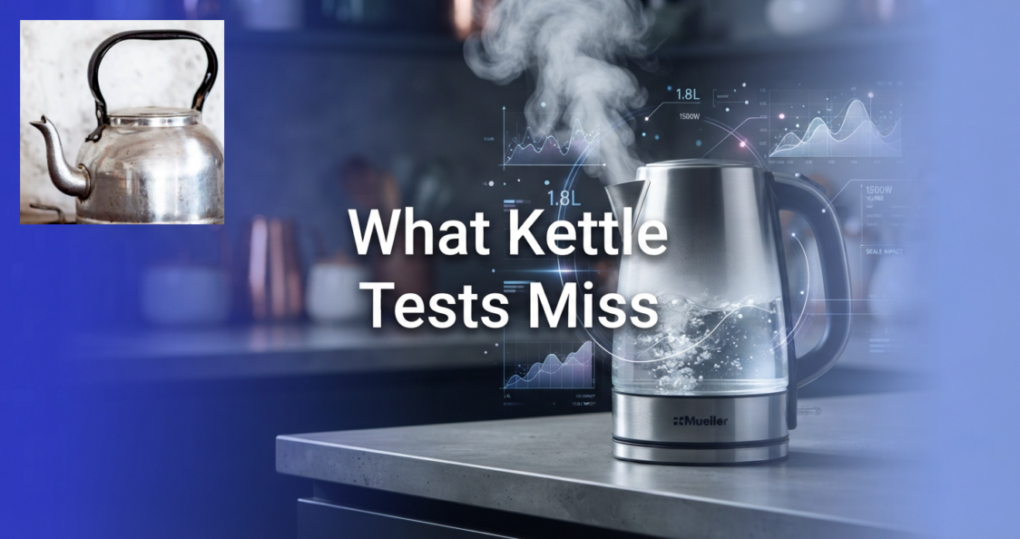
Electric Kettle Speed Tests
Latest Update: November 19, 2026
Electric Kettle Speed Tests can reveal how quickly water heats, but the time means little unless the test conditions match. A useful claim states the water amount, starting temperature, endpoint, and repeat results; without them, it cannot show which kettle will be faster for your use. We explain how to run a fair comparison and why a quick boil does not automatically mean lower energy use.
Key Takeaways
- Match the test conditions. Use the same water quantity, starting temperature, fill level, room conditions, and timer method for each run.
- Decide what counts as boiling. Use one consistent endpoint for every kettle, and account for differences between an electric kettle shutoff and a stovetop kettle whistle.
- Repeat the test. Run each comparison at least three times, then report the spread of results as well as the average.
- Read power specifications together. Wattage, voltage, current, heating design, and the electrical supply all affect the power available for heating.
- Measure energy separately. A shorter boil time does not prove that a kettle used less electricity.
- Choose for everyday use. Capacity, pouring, cleaning access, and automatic shutoff matter alongside the shortest measured time.
Set up a repeatable kettle speed test
A useful Electric Kettle Speed Test starts with the same amount of water every time. Weigh the water rather than estimating it from the kettle markings, because even a small difference in quantity changes how much energy the water needs.
Set the same starting water temperature and fill level for each run. Warmer water reaches the endpoint sooner, so a kettle tested with warmer water has an unfair advantage.
Keep the room and setup consistent, including the counter location and the way you position the kettle. Repeat each test at least three times, since one unusual run should not decide the comparison.
Use the same timer method each time and write down the water quantity, starting temperature, endpoint, and number of repeats. Our guide to comparing fast boiling electric kettles follows the same principle, a time is meaningful only when its conditions are clear.
For a practical start, you can use the two glass kettle examples below to think through consistent filling and timing. The images illustrate kettle forms, while the test method remains the same for any model.

We can report a result clearly with a compact record: water mass, initial temperature, finish line, elapsed time for each run, and the average time.
That gives readers enough context to judge whether two electric kettle speed tests are genuinely comparable.
Decide whether you want an apples-to-apples speed test or a real-world capacity test. For the first, heat the same measured batch in every kettle; it isolates differences under that task.
For the second, test each kettle at the amount you would normally heat, and label the result as a use-case comparison, not a pure design comparison.
Do not rank a small-batch result against a full-capacity result as though they were the same test.
Agree on what counts as boiling
Set the finish line before starting the timer. You can define it as reaching the local boiling temperature or as the electric kettle switching off automatically, but use the same endpoint throughout the comparison.
For a stovetop kettle, a whistle is a signal from the kettle, not automatically the same endpoint as an electric kettle shutoff. Compare those signals only when both have been calibrated to the same water temperature.
At sea level and standard air pressure, water boils at 212 degrees Fahrenheit, or 100 degrees Celsius, according to Inside Energy. Altitude changes the boiling point, so a test in a high location may finish at a lower temperature than one at sea level.
If the difference between two average times is close to the variation among repeat runs, call the outcome inconclusive. A small timing gap is not a reliable winner when ordinary run to run differences are just as large.


When we compare an electric kettle with a stovetop kettle, a shared temperature endpoint makes the comparison more useful than relying on a whistle or a visual cue alone. It also helps explain why a claimed boiling time can be difficult to interpret without a stated method.
Temperature settings and accuracy
Preset controls answer a different question from a boil-speed test: they target a chosen water temperature rather than a rolling boil or automatic shutoff.
Treat the displayed setting as a target, not proof of the water’s temperature when poured. Sensor location, heat retained in the kettle, and cooling during pouring can all affect the delivered temperature.
To compare temperature settings, use the same water amount and starting temperature, and select the same target on each kettle where possible.
Check the water with a thermometer at a consistent point just before pouring, keeping the probe clear of the kettle’s sides and base. Record both the selected target and the measured temperature; judge temperature control separately from boil speed.
Control water quantity and starting temperature
Measured water mass is more reliable than an approximate fill. Heating more water takes more energy and usually more time, so the same water quantity is essential when comparing kettle designs.
Let water return to the same starting temperature before each run. This removes an easy source of unfair advantage, especially when one test follows shortly after another.
The Hamilton Beach 1 Liter Electric Tea Kettle Water Boiler And Heater 1500W and Mueller Ultra Kettle make a useful capacity comparison.
Hamilton Beach is a 1 litre kettle with a 1500 watt heating element, cordless countertop base, automatic shutoff, boil dry protection, indicator light, and included mesh filter, priced at $24.99.
The Mueller Ultra Kettle holds 1.8 litres and also has a 1500 watt element, along with a borosilicate glass body, stainless steel base, LED indicator lights, automatic shutoff, boil dry protection, and removable filter, priced at $33. These specifications help describe each kettle, but capacity and wattage alone do not establish which will boil a particular quantity faster.
The key comparison remains the same water mass, same starting temperature, and same endpoint.

For everyday use, the Hamilton Beach size may suit a smaller measured batch, while the Mueller offers more capacity for several servings.
A larger kettle can be useful, but the test should use the same quantity in each kettle rather than filling each to its maximum.
Treat this efficiency estimate as a reported result, not a fixed property of every electric kettle.
Before using it to compare appliances, check how the source defines efficiency and what energy boundary, water amount, starting temperature, and endpoint its experiment used.
Without that context, the figure cannot predict the energy use of a particular kettle in your kitchen.
Read wattage, voltage, and current together
Wattage describes the rate of electrical power input. When water quantity, starting temperature, and heat losses are alike, more usable power can shorten heating time.
Voltage alone does not determine boil speed. Electrical power depends on both voltage and current, and the supply can limit the power an appliance draws.
Record the kettle’s rated wattage and the electrical supply conditions during the test. This gives readers a clearer account than attributing a result to voltage alone, and it helps explain why two kettles with similar labels may perform differently in a particular setup.
The Azeus Fast Boil Electric Kettle has a 1.8 litre borosilicate glass body, stainless steel base, 304 stainless steel interior, and wattage up to 1800 watts depending on the model. Its price is $21.04, and the model’s actual rated wattage is essential context for a speed test.
For a closer explanation of why a higher wattage label does not settle the result, read our comparison of 1500 watt and 3000 watt kettle claims. It is a useful reminder to consider the electrical supply and the complete heating system alongside the number on the label.

Why might an American kettle take longer? A kettle can take longer when its usable wattage is lower for the tested water quantity, but voltage by itself does not explain the result.
If current and the appliance’s rated power differ, voltage alone does not determine whether a lower voltage kettle takes longer.
Compare stovetop results with the burner in mind
Record the stove type and burner setting for every stovetop kettle test. Electric resistance, gas, and induction transfer heat to the kettle in different ways, and burner output can vary with the setup.
Use the same burner, kettle position, lid, and water quantity for repeat runs. A different burner setting, pan position, or flame changes the heat reaching the water and can alter the boil time.
A well fitting lid helps limit heat loss, and centering the kettle over the active heating area keeps the test focused on heating the water. Do not treat one stovetop result as a prediction for every stove or every kitchen.
An electric kettle may boil faster than a stovetop kettle because its heating element transfers heat within the kettle rather than relying on a burner to heat the vessel from outside. The actual comparison still depends on the water quantity, appliance power, stove, and test endpoint.

How much can the burner affect a stovetop speed test? Enough to make results from different burners difficult to compare directly, which is why the stove type and setting belong in the test notes.
For electric kettle and stovetop comparisons, use the same endpoint and water conditions before drawing a conclusion.
Separate boil time from energy use
Measure energy use separately from elapsed time. A faster result does not by itself prove that the kettle used less electricity, because power input and heating duration both contribute to energy consumed.
For a fair energy comparison, heat the same water mass from the same starting temperature to the same endpoint and record energy use for every run.
Our tea kettle boiling time and energy cost calculator uses inputs such as water volume, heat source, power rating, and starting temperature to help organize those comparisons.
Boil only the water needed for the task when practical. Heating extra water adds time and uses energy, even if the kettle is capable of holding a larger batch.

The diagram highlights why speed and energy use are separate test results.

Do rapid boil kettles use more electricity? A higher power input can shorten the time needed for a given task, while the total energy result depends on the full run. The clean comparison records both time and energy instead of using either one as a substitute for the other.
The burner-transfer figures on this card describe particular experimental arrangements, not a universal gas-stove efficiency. Flame size, vessel shape and position, and the method used to calculate transferred energy can affect the result. Do not compare these figures directly with electric-kettle efficiency unless the energy boundaries and heating task are comparable.
Weigh everyday handling alongside speed
Boil time is only one part of choosing a kettle. Capacity, pouring control, cleaning access, and automatic shutoff shape how comfortably the appliance fits into a daily ritual.
A larger capacity can serve several people at once, while a smaller measured fill can avoid heating water that will not be used.
Consider whether the handle and spout feel manageable when the kettle is full, and whether the opening gives you room to clean the interior.
What is the best electric tea kettle? The best choice depends on whether you value temperature control, a comfortable pour, easy cleaning, or speed most. For speed, no universal winner is meaningful without matched water conditions and repeat results.
Compare kettles using your usual fill, and treat a small timing advantage cautiously when it is close to the variation between runs.
When results are close, give the repeat range and conditions rather than turning a small timing difference into a broad claim. This is what electric kettle speed tests often miss, the test method matters as much as the headline time.

The product descriptions here give specifications and use-case context, not controlled side-by-side boil times. No comparative timings are reported, so none of the named models can be called the fastest on this basis.
To make a decision, test with your usual water amount and starting temperature, compare repeat times, and measure energy separately; choose a quick result only if the kettle’s capacity and everyday handling suit you too.
Frequently Asked Questions
Can limescale change how quickly an electric kettle boils?
Yes, a layer of mineral scale on the heating surface can slow heat transfer and make a kettle take longer to reach its shutoff point. Descaling according to the appliance care instructions helps remove that buildup.
Why does an electric kettle sound different as the water heats?
The sound changes as bubbles form at the heating surface, rise through the water, and release steam near the surface. The pattern of bubbling and vibration shifts as the water gets hotter.
Can you boil only a small amount of water in a large kettle?
Yes, as long as the water remains above the kettle’s minimum fill mark. That mark helps ensure the heating area stays covered and the kettle operates as intended.
Can boiling water in an electric kettle save time when cooking?
It can shorten the wait for hot water when a recipe needs boiling water added to a pot or bowl. The overall cooking time still depends on the recipe and the time needed for the food to cook.
Do electric kettle speed tests need a thermometer?
A thermometer helps when a test uses a specific water temperature rather than an automatic shutoff as its endpoint. Choose a thermometer suited to hot liquids and keep its sensing tip clear of the kettle’s base and sides.
See also: B00PWuYpF.
Conclusion
Electric Kettle Speed Tests, What Boiling Claims Miss comes down to fair conditions, a clear finish line, and separate measurements for time and energy.
Use the same water quantity and starting temperature, repeat each run, and record the power and setup details.
The shortest boil time is useful only when it reflects a repeatable test and suits your daily needs. With that context, a kettle comparison becomes more reliable than any isolated boiling claim.




Pingback: Cuisinart Soho 1.0 L Review: Price, Pros, and Cons for 2026
Pingback: Paris Rhone Electric Tea Kettle Retro: Full 2027 Review